
Tag: marketing

  • Amazon’s Modular Fulfillment Strategy: Boundaryless Organization at Scale

    Amazon’s Modular Fulfillment Strategy: Boundaryless Organization at Scale

    Andy Jassy’s April 2026 shareholder letter revealed Amazon’s operational buildout: over 1 million robots across fulfillment centers, $4 billion committed to rural delivery, 85+ Same Day Fulfillment Centers delivering 500 million units, Prime Air drones serving 30 million customers by year-end, 241 satellites launched for Amazon Leo.

    The Modular Boundaryless Model

    Boundaryless organizations take three forms: barrier-free (permeable internal boundaries), modular (outsourcing noncore activities), and virtual (partnerships among independent entities). Amazon’s fulfillment strategy deploys modular design at unprecedented scale.

    Traditional modular organizations outsource specific functions. Amazon inverts this: multiple specialized internal modules, each optimized for different delivery speeds and geographies, operate semi-independently while maintaining seamless coordination.

    The modules: traditional fulfillment centers (1-2 day delivery), Same Day Fulfillment Centers carrying top 90,000 SKUs, micro-fulfillment centers for 20-minute delivery (360+ in India), Prime Air drone hubs (sub-30-minute delivery), and Amazon Leo satellite network for rural connectivity.

    Each addresses a specific customer need with distinct infrastructure and performance metrics. Together they create delivery optionality single-structure networks can’t match.

    Boundaries Extending Outward

    Jassy’s letter hints at evolution: “Wherever we can leverage our scale and real-time feedback loop from so many robots in our fulfillment network to build robotics solutions for other industrial and consumer customers, we’ll explore doing so.”

    This represents external boundary permeability. Amazon’s 1 million robots generate operational data at scale. Learnings from coordinating autonomous systems across hundreds of facilities create expertise extending beyond fulfillment.

    Selling robotics solutions would transform Amazon’s modular structure from purely internal to hybrid internal-external. Amazon becomes both operator and vendor of fulfillment technology.

    The Leo satellite constellation demonstrates similar logic—built for Amazon’s needs, capable of serving external customers. Infrastructure designed for internal use that scales to external markets, mirroring how AWS emerged from Amazon’s internal infrastructure and became standalone business.

    Strategic Implications

    The $4 billion rural commitment, 85+ SSDs, 360+ micro-fulfillment centers, Prime Air scaling, and Leo constellation represent organizational structure as strategic weapon. Jassy frames these as “squiggly lines” rather than straight paths. Modular boundaryless design embraces organizational complexity to unlock strategic optionality. The structure itself becomes competitive advantage.

    Sources & Notes

    This analysis applies boundaryless organizational design concepts to Amazon’s fulfillment infrastructure detailed in CEO Andy Jassy’s 2025 Letter to Shareholders.

    All interpretations and strategic conclusions represent independent analysis.
  • Amazon’s Business-Level Strategy: Combining Cost Leadership and Differentiation

    Amazon’s Business-Level Strategy: Combining Cost Leadership and Differentiation

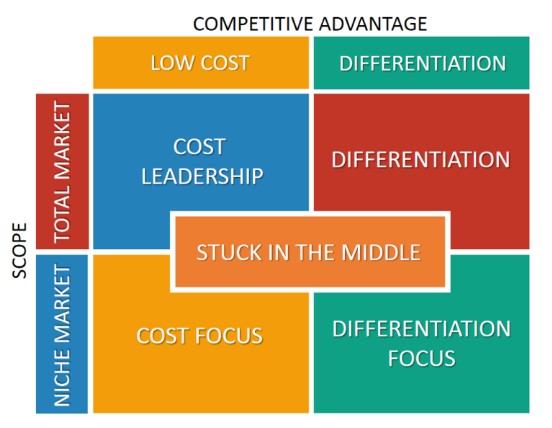
    Diagram showing low cost and differentiation strategies across broad and niche market scopes.
    Visualizing strategic positioning for competitive advantage across market scope and competitive advantage dimensions, foundational to business-level strategy analysis.

    Amazon’s position as a dominant competitor in global e-commerce and related services reflects not just scale, but how it competes at the business level. According to Porter’s generic strategies, a firm seeking a sustainable competitive advantage must choose a strategic position based on cost leadership or differentiation within a target market.

    Unlike many firms that pursue one or the other, Amazon demonstrates a hybrid business-level strategy that blends cost leadership with meaningful differentiation across its core markets. By doing so, Amazon aligns customer value with operational excellence, creating strategic advantages that are difficult for competitors to replicate.


    Cost Leadership: Low Prices Through Operational Efficiency

    At its core, Amazon competes aggressively on cost. The company’s fulfillment operations, extensive logistics network, and tight integration of automation and data analytics allow it to operate with exceptionally low unit costs. Amazon passes a portion of these savings to customers in the form of lower prices.

    From its beginnings as an online bookseller, Amazon has placed range, price, and convenience at the center of its strategy, consistently investing in process improvements and innovations that reduce expenses across the value chain. Achieving cost leadership in this way supports the company’s ability to offer competitive pricing while maintaining profit margins through scale and efficiency.


    Differentiation: Experience and Ecosystem Value

    While cost leadership explains Amazon’s ability to compete on price, it does not fully explain customer loyalty or sustained competitive advantage. Amazon also differentiates itself through services and experiences that competitors struggle to match.

    Examples include:

    • Fast and reliable delivery (Next-day, same-day, and ultra-fast options) that improve customer experience and create convenience value that other retailers find difficult to match cost-effectively.
    • Broader ecosystem services such as Prime membership benefits, AWS cloud services, digital media, and advertising platforms that expand value beyond simple product transactions.

    This differentiation strategy reinforces customer retention and increases switching costs, creating a value proposition that combines low price with high value.


    The Power of Hybrid Strategy

    Traditional strategic frameworks often suggest that firms must choose either cost leadership or differentiation, because pursuing both can dilute focus or increase complexity. However, Amazon shows that a hybrid approach can succeed when it is supported by strong internal capabilities like advanced logistics, data analytics, and investment in technology.

    By integrating these capabilities into daily operations, Amazon manages to:

    • keep prices competitive,
    • improve delivery speed and reliability,
    • enhance customer experience across channels,
    • expand its product and service ecosystem,
    • and capture value from multiple revenue streams.

    This hybridization enables Amazon to thrive across diverse customer segments without being stuck in the middle, a common strategic trap when firms lack a clear business-level approach.


    Strategic Implications and Future Considerations

    At the business level, Amazon’s hybrid strategy has two key implications:

    1. Competitive Resilience: By combining cost and differentiation, Amazon retains flexibility to respond to competitive pressures from rivals like Walmart on price and niche specialists on service or specialization.
    2. Operational Complexity: Executing a hybrid strategy requires advanced coordination across functions, from fulfillment optimization to customer service and digital platform management. This complexity becomes an advantage when Amazon’s organizational capabilities harness it effectively.

    However, hybrid strategies can be difficult to defend without robust capabilities, which raises the importance of internal systems, data integration, and strategic coherence; themes you’ve seen explored in earlier blog posts about fulfillment and intellectual assets.

    As Amazon continues to innovate its ability to sustain competitive advantage will depend on whether it can maintain this hybrid strategic balance while managing costs and delivering differentiation value.


    Sources & Notes

    This analysis uses publicly available information on Amazon’s competitive strategy and business-level positioning, including research on generic strategies and Amazon’s operational approach in cost leadership and differentiation. Sources include business strategy analysis platforms and industry reports. All interpretations and conclusions reflect the author’s independent analysis.