Tag: leadership

  • Amazon’s Business-Level Strategy: Combining Cost Leadership and Differentiation

    Amazon’s Business-Level Strategy: Combining Cost Leadership and Differentiation

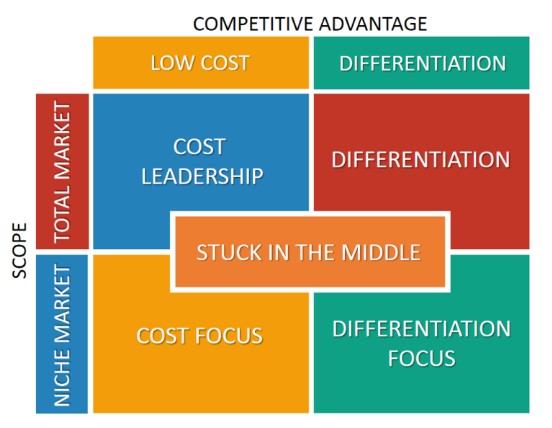
    Diagram showing low cost and differentiation strategies across broad and niche market scopes.
    Visualizing strategic positioning for competitive advantage across market scope and competitive advantage dimensions, foundational to business-level strategy analysis.

    Amazon’s position as a dominant competitor in global e-commerce and related services reflects not just scale, but how it competes at the business level. According to Porter’s generic strategies, a firm seeking a sustainable competitive advantage must choose a strategic position based on cost leadership or differentiation within a target market.

    Unlike many firms that pursue one or the other, Amazon demonstrates a hybrid business-level strategy that blends cost leadership with meaningful differentiation across its core markets. By doing so, Amazon aligns customer value with operational excellence, creating strategic advantages that are difficult for competitors to replicate.


    Cost Leadership: Low Prices Through Operational Efficiency

    At its core, Amazon competes aggressively on cost. The company’s fulfillment operations, extensive logistics network, and tight integration of automation and data analytics allow it to operate with exceptionally low unit costs. Amazon passes a portion of these savings to customers in the form of lower prices.

    From its beginnings as an online bookseller, Amazon has placed range, price, and convenience at the center of its strategy, consistently investing in process improvements and innovations that reduce expenses across the value chain. Achieving cost leadership in this way supports the company’s ability to offer competitive pricing while maintaining profit margins through scale and efficiency.


    Differentiation: Experience and Ecosystem Value

    While cost leadership explains Amazon’s ability to compete on price, it does not fully explain customer loyalty or sustained competitive advantage. Amazon also differentiates itself through services and experiences that competitors struggle to match.

    Examples include:

    • Fast and reliable delivery (Next-day, same-day, and ultra-fast options) that improve customer experience and create convenience value that other retailers find difficult to match cost-effectively.
    • Broader ecosystem services such as Prime membership benefits, AWS cloud services, digital media, and advertising platforms that expand value beyond simple product transactions.

    This differentiation strategy reinforces customer retention and increases switching costs, creating a value proposition that combines low price with high value.


    The Power of Hybrid Strategy

    Traditional strategic frameworks often suggest that firms must choose either cost leadership or differentiation, because pursuing both can dilute focus or increase complexity. However, Amazon shows that a hybrid approach can succeed when it is supported by strong internal capabilities like advanced logistics, data analytics, and investment in technology.

    By integrating these capabilities into daily operations, Amazon manages to:

    • keep prices competitive,
    • improve delivery speed and reliability,
    • enhance customer experience across channels,
    • expand its product and service ecosystem,
    • and capture value from multiple revenue streams.

    This hybridization enables Amazon to thrive across diverse customer segments without being stuck in the middle, a common strategic trap when firms lack a clear business-level approach.


    Strategic Implications and Future Considerations

    At the business level, Amazon’s hybrid strategy has two key implications:

    1. Competitive Resilience: By combining cost and differentiation, Amazon retains flexibility to respond to competitive pressures from rivals like Walmart on price and niche specialists on service or specialization.
    2. Operational Complexity: Executing a hybrid strategy requires advanced coordination across functions, from fulfillment optimization to customer service and digital platform management. This complexity becomes an advantage when Amazon’s organizational capabilities harness it effectively.

    However, hybrid strategies can be difficult to defend without robust capabilities, which raises the importance of internal systems, data integration, and strategic coherence; themes you’ve seen explored in earlier blog posts about fulfillment and intellectual assets.

    As Amazon continues to innovate its ability to sustain competitive advantage will depend on whether it can maintain this hybrid strategic balance while managing costs and delivering differentiation value.


    Sources & Notes

    This analysis uses publicly available information on Amazon’s competitive strategy and business-level positioning, including research on generic strategies and Amazon’s operational approach in cost leadership and differentiation. Sources include business strategy analysis platforms and industry reports. All interpretations and conclusions reflect the author’s independent analysis.


  • Amazon’s Competitive Advantage Through a Resource-Based Lens

    Amazon’s Competitive Advantage Through a Resource-Based Lens

    Amazon fulfillment and logistics network illustrating integrated operational capabilities
    Amazon’s logistics network demonstrates how operational capabilities, when integrated at scale, can become difficult for competitors to replicate.

    Amazon continues to attract attention for its scale, a global fulfillment footprint, and an ever-expanding portfolio of automation and AI investments. Yet scale alone does not explain why competitors with similar capital access and technology struggle to replicate Amazon’s performance. A more useful explanation emerges when Amazon’s strategy is examined through the Resource-Based View (RBV) of the firm, particularly when paired with the VRIO framework.

    Rather than relying on a single breakthrough technology or cost advantage, Amazon’s competitive position is rooted in the way it integrates physical assets, data, and organizational capabilities into a tightly coordinated fulfillment system. This integration transforms otherwise imitable resources into a sustainable competitive advantage.


    Resource-Based View: Moving Beyond Assets

    The RBV argues that firms achieve sustained competitive advantage not merely by acquiring resources, but by developing valuable, rare, inimitable, and well-organized combinations of resources and capabilities. In Amazon’s case, the most visible assets; fulfillment centers, robotics, transportation fleets, and cloud infrastructure; are not inherently unique. Competitors can and do purchase similar equipment.

    What differentiates Amazon is how these assets are embedded within organizational processes, reinforced by proprietary data, and continuously refined through operational learning. The firm’s resources function as a system rather than as isolated components, making replication difficult even for well-capitalized rivals.


    Applying VRIO to Amazon’s Fulfillment Network

    Valuable

    Amazon’s fulfillment resources directly support speed, reliability, and cost efficiency; three dimensions that customers consistently value. Regionalized fulfillment networks, same-day delivery capabilities, and advanced demand forecasting reduce last-mile costs while improving service levels. These outcomes are strategically valuable because they reinforce customer loyalty and increase switching costs.

    Rare

    While individual technologies such as robotics or warehouse management systems are widely available, Amazon’s network density and data feedback loops are rare. Few firms operate at a scale where order data, inventory positioning, transportation routing, and customer behavior continuously inform one another in near real time. This rarity stems not from technology itself, but from years of accumulated operational data and process refinement.

    Inimitable

    Amazon’s fulfillment advantage is difficult to imitate due to path dependency. The firm’s current capabilities are the result of long-term investment decisions, experimentation, and organizational learning. Competitors attempting to replicate this system face not only high capital requirements, but also the challenge of compressing years of operational experience into a much shorter timeframe. Additionally, Amazon’s culture of experimentation and tolerance for short-term inefficiency in pursuit of long-term gains further raises imitation barriers.

    Organized

    Perhaps the most critical, and often overlooked, element is Amazon’s ability to organize around its resources. Incentive structures, performance metrics, and decision rights are aligned to support rapid execution and continuous improvement. Automation and AI are not treated as standalone initiatives; they are operational tools integrated into daily decision-making across fulfillment, transportation, and inventory planning.


    Why Competitors Struggle to Replicate Amazon

    Many competitors focus on acquiring visible components of Amazon’s system without replicating the organizational structure required to support them. As a result, similar assets often produce weaker outcomes. This highlights a central RBV insight: resources create advantage only when paired with complementary capabilities and organizational alignment.

    Retailers and logistics providers that treat fulfillment as a cost center rather than a strategic capability are unlikely to close the gap. Amazon’s advantage persists not because others lack access to technology, but because they lack the integrated system that turns those technologies into sustained performance.


    Strategic Implications

    Amazon’s fulfillment strategy illustrates how competitive advantage increasingly resides in capability systems, not individual assets. As automation and AI become more accessible, the differentiator will be a firm’s ability to integrate these tools into coherent operating models. For Amazon, this suggests that its advantage is most defensible where physical infrastructure, data, and organizational processes intersect.

    However, the same factors that make Amazon’s advantage durable also introduce risks. Regulatory scrutiny, labor constraints, and diminishing marginal returns on infrastructure investment may test the limits of this model. Still, from a resource-based perspective, Amazon remains exceptionally well-positioned to adapt, precisely because its advantage is rooted in capabilities rather than commodities.


    Sources & Notes

    • Amazon.com, Inc. Shareholder Letters and Earnings Commentary
    • Recent coverage from The Wall Street Journal, Bloomberg, and Financial Times on Amazon logistics and automation investments

    This analysis applies the Resource-Based View and VRIO framework to publicly available information and reflects independent interpretation.