
Category: Amazon Analysis

  • Amazon’s Corporate-Level Strategy: Vertical Integration as Competitive Control

    Amazon’s Corporate-Level Strategy: Vertical Integration as Competitive Control

    Amazon’s competitive advantage cannot be fully understood at the business level alone. While cost leadership and differentiation explain how Amazon competes within markets, its broader strength emerges from corporate-level strategy, particularly its deliberate and expanding use of vertical integration.

    Corporate-level strategy addresses the scope of the firm: where it competes and how its various business units create value together. Amazon provides a compelling case study of how vertical integration can increase control, reduce dependency, and reinforce long-term strategic positioning.


    Understanding Vertical Integration

    Vertical integration occurs when a firm expands its activities into different stages of the value chain, either upstream toward suppliers or downstream toward distribution and customers.

    For Amazon, vertical integration has not been incidental. It has been systematic and strategic.

    Rather than relying solely on third-party logistics providers, payment processors, chip manufacturers, or streaming distributors, Amazon has gradually internalized these functions.


    Upstream Integration: Owning Critical Inputs

    Amazon has increasingly moved upstream to control key inputs that influence cost and performance.

    Examples include:

    • Designing its own AI and cloud infrastructure chips for AWS
    • Expanding private-label product lines
    • Building proprietary robotics and warehouse automation systems

    By internalizing these inputs, Amazon reduces supplier power, protects margins, and ensures tighter coordination between engineering, logistics, and product strategy.

    Upstream integration also protects intellectual assets. When knowledge remains internal, competitors face greater barriers to imitation.


    Downstream Integration: Controlling Distribution and Customer Access

    Perhaps Amazon’s most visible corporate-level strategy is downstream integration.

    Rather than depending fully on UPS, FedEx, or USPS, Amazon has built:

    • Its own last-mile delivery network
    • Air cargo operations (Amazon Air)
    • Regional fulfillment networks

    This downstream integration reduces dependency on external logistics providers while improving delivery speed and cost control.

    It also creates a strategic advantage: Amazon can optimize pricing and delivery promises because it owns the distribution mechanism.


    Related Diversification: Reinforcing the Ecosystem

    Beyond vertical integration, Amazon’s diversification into AWS, advertising, streaming, and devices represents related diversification that strengthens its ecosystem.

    Each business unit reinforces the others:

    • AWS supports internal infrastructure and generates cash flow.
    • Advertising monetizes marketplace traffic.
    • Prime Video strengthens customer retention.
    • Devices deepen platform engagement.

    This interconnectedness creates corporate-level synergies, the whole becomes more valuable than the individual units.


    Risks of Vertical Integration

    While vertical integration offers control and efficiency, it also increases:

    • Capital intensity
    • Organizational complexity
    • Regulatory scrutiny

    Amazon’s size and scope have drawn increased antitrust attention, particularly regarding its marketplace and logistics integration.

    Corporate-level strategy must balance efficiency gains with strategic flexibility and regulatory risk.


    Strategic Implications

    Amazon’s corporate-level strategy demonstrates how vertical integration can create sustained competitive advantage when paired with operational excellence and intellectual assets.

    By owning more of its value chain, Amazon reduces uncertainty, protects margins, and improves coordination across business units.

    However, this strategy also commits the firm to high fixed costs and structural complexity.

    As competition intensifies and regulation evolves, Amazon’s ability to manage its integrated structure without becoming rigid will determine whether its corporate-level advantage remains durable.


    Sources & Notes

    This analysis applies corporate-level strategy concepts to publicly available information about Amazon’s logistics, AWS infrastructure, and ecosystem development.

    All interpretations and conclusions represent independent strategic analysis.
  • Amazon’s Business-Level Strategy: Combining Cost Leadership and Differentiation

    Amazon’s Business-Level Strategy: Combining Cost Leadership and Differentiation

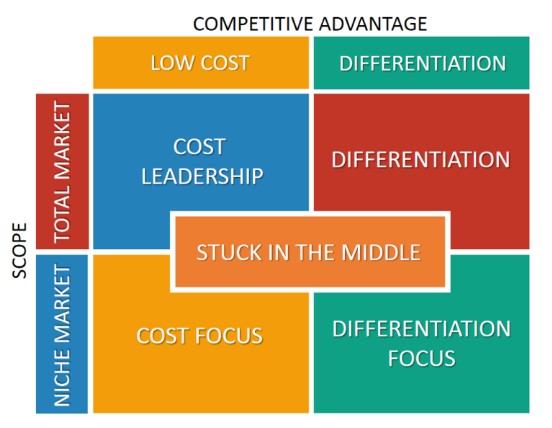
    Diagram showing low cost and differentiation strategies across broad and niche market scopes.
    Visualizing strategic positioning for competitive advantage across market scope and competitive advantage dimensions, foundational to business-level strategy analysis.

    Amazon’s position as a dominant competitor in global e-commerce and related services reflects not just scale, but how it competes at the business level. According to Porter’s generic strategies, a firm seeking a sustainable competitive advantage must choose a strategic position based on cost leadership or differentiation within a target market.

    Unlike many firms that pursue one or the other, Amazon demonstrates a hybrid business-level strategy that blends cost leadership with meaningful differentiation across its core markets. By doing so, Amazon aligns customer value with operational excellence, creating strategic advantages that are difficult for competitors to replicate.


    Cost Leadership: Low Prices Through Operational Efficiency

    At its core, Amazon competes aggressively on cost. The company’s fulfillment operations, extensive logistics network, and tight integration of automation and data analytics allow it to operate with exceptionally low unit costs. Amazon passes a portion of these savings to customers in the form of lower prices.

    From its beginnings as an online bookseller, Amazon has placed range, price, and convenience at the center of its strategy, consistently investing in process improvements and innovations that reduce expenses across the value chain. Achieving cost leadership in this way supports the company’s ability to offer competitive pricing while maintaining profit margins through scale and efficiency.


    Differentiation: Experience and Ecosystem Value

    While cost leadership explains Amazon’s ability to compete on price, it does not fully explain customer loyalty or sustained competitive advantage. Amazon also differentiates itself through services and experiences that competitors struggle to match.

    Examples include:

    • Fast and reliable delivery (Next-day, same-day, and ultra-fast options) that improve customer experience and create convenience value that other retailers find difficult to match cost-effectively.
    • Broader ecosystem services such as Prime membership benefits, AWS cloud services, digital media, and advertising platforms that expand value beyond simple product transactions.

    This differentiation strategy reinforces customer retention and increases switching costs, creating a value proposition that combines low price with high value.


    The Power of Hybrid Strategy

    Traditional strategic frameworks often suggest that firms must choose either cost leadership or differentiation, because pursuing both can dilute focus or increase complexity. However, Amazon shows that a hybrid approach can succeed when it is supported by strong internal capabilities like advanced logistics, data analytics, and investment in technology.

    By integrating these capabilities into daily operations, Amazon manages to:

    • keep prices competitive,
    • improve delivery speed and reliability,
    • enhance customer experience across channels,
    • expand its product and service ecosystem,
    • and capture value from multiple revenue streams.

    This hybridization enables Amazon to thrive across diverse customer segments without being stuck in the middle, a common strategic trap when firms lack a clear business-level approach.


    Strategic Implications and Future Considerations

    At the business level, Amazon’s hybrid strategy has two key implications:

    1. Competitive Resilience: By combining cost and differentiation, Amazon retains flexibility to respond to competitive pressures from rivals like Walmart on price and niche specialists on service or specialization.
    2. Operational Complexity: Executing a hybrid strategy requires advanced coordination across functions, from fulfillment optimization to customer service and digital platform management. This complexity becomes an advantage when Amazon’s organizational capabilities harness it effectively.

    However, hybrid strategies can be difficult to defend without robust capabilities, which raises the importance of internal systems, data integration, and strategic coherence; themes you’ve seen explored in earlier blog posts about fulfillment and intellectual assets.

    As Amazon continues to innovate its ability to sustain competitive advantage will depend on whether it can maintain this hybrid strategic balance while managing costs and delivering differentiation value.


    Sources & Notes

    This analysis uses publicly available information on Amazon’s competitive strategy and business-level positioning, including research on generic strategies and Amazon’s operational approach in cost leadership and differentiation. Sources include business strategy analysis platforms and industry reports. All interpretations and conclusions reflect the author’s independent analysis.


  • Intellectual Assets and Competitive Advantage at Amazon

    Intellectual Assets and Competitive Advantage at Amazon

    Amazon fulfillment operations integrating human workers and AI-driven automation systems.
    Amazon’s competitive advantage increasingly depends on the integration of human expertise and AI-driven systems, illustrating how intellectual assets; organizational knowledge, process discipline, and structural learning; amplify the value of physical infrastructure.

    Amazon’s competitive advantage is often discussed in terms of warehouses, robotics, and cloud infrastructure. Tangible assets are important, but they tell only part of the story. To understand Amazon’s sustained strategic position, it is essential to look at its intellectual assets; the knowledge, capabilities, and organizational structures that allow it to put technology and physical resources to strategic use. These intangible strengths amplify the value of Amazon’s tangible investments and make the firm’s advantage more durable.

    Intellectual assets are increasingly critical in competitive strategy because they govern how effectively a firm uses its tangible resources. Amazon’s recent moves; especially around automation, artificial intelligence (AI), and organizational redesign—highlight how intellectual assets act as multipliers for operational capability and future growth.


    Human Capital and Organizational Capability

    One of Amazon’s most valuable intellectual assets is its internal human capital: the engineers, operations experts, and cross-functional teams that continually refine complex systems. Amazon’s organizational structure blends hierarchical oversight with autonomous project teams, allowing small teams to drive innovation while aligning with broader corporate goals. This structure supports rapid experimentation and knowledge transfer across units, minimizing barriers to scaling successful practices.

    Unlike firms that focus solely on hardware or software investments, Amazon embeds its human capital into ongoing improvement cycles. Workers and leaders are expected to contribute to process refinement, not just task execution. This creates a learning organization, one that improves not just because it has resources, but because it knows how to apply and adapt them over time.


    Data, Algorithms, and Structural Knowledge

    Intellectual assets also include data and the systems that interpret it. Amazon’s vast customer, inventory, and logistics data streams are not just stored; they are actively integrated into decision-making processes across the company. Sophisticated algorithms optimize pricing, routing, inventory placement, and demand forecasting—actions that tangible assets alone cannot accomplish.

    This integration of data into operational routines means that Amazon’s fulfillment network becomes smarter with scale. Instead of treating data as a by-product, Amazon turns it into structural knowledge: a repository of patterns and insights that improve efficiency and responsiveness. Competitors can buy robotics or AI tools, but without a deep, integrated knowledge base and the capability to act on it, those tools deliver limited benefit.


    Investments in AI and Long-Term Structural Advantage

    Recent strategic commitments underscore how Amazon is betting on intellectual assets to extend its advantage. The company announced plans for massive capital expenditures, reportedly as high as $200 billion focused largely on AI and cloud infrastructure. These investments, aimed at in-house data centers, specialized chips, and AI model development, reinforce organizational knowledge as a strategic asset.

    By building AI capabilities internally, Amazon moves beyond purchasing third-party solutions. Proprietary models and infrastructure become part of the firm’s differentiated capabilities—asset combinations that are difficult for competitors to replicate meaningfully. These intellectual assets tie directly to how the firm analyzes demand, manages inventory, and automates fulfillment execution, reinforcing the notion that competitive advantage stems from capability systems, not isolated tools.


    Social Capital and Collaborative Knowledge

    Another dimension of intellectual assets is social capital; the networks, norms, and shared understandings that facilitate coordination and cooperation. Amazon’s engineering culture, leadership principles, and internal communication protocols foster a shared language for solving complex problems. Teams are structured to transfer insights efficiently across functions and geographies, reducing knowledge silos.

    This social capital matters because knowledge that is locked in individuals or isolated teams does not generate competitive advantage at scale. Amazon’s ability to share, codify, and institutionalize insights across its global operations helps it operationalize innovation more consistently than competitors.


    Intellectual Assets vs. Rigidities

    It is important to note that intellectual assets can also become source of rigidity if not managed well. Over-specialization, entrenched practices, or excessive focus on internal tools can inhibit responsiveness to new strategic threats. Amazon’s ongoing restructuring of its AI teams and leadership to better align with competitive dynamics suggests it is actively managing this tension.


    Strategic Implications

    Amazon’s intellectual assets; human capital, structural knowledge, social capital, and proprietary AI capability; are central to the firm’s ability to sustain competitive advantage. These assets influence how Amazon uses its physical infrastructure, how it innovates at scale, and how it adapts to emerging competitive pressures. Tangible resources like warehouses and robotics matter only insofar as the company’s intellectual systems harness them effectively.

    Recognizing and strengthening intellectual assets allows Amazon to respond proactively to competitive, technological, and regulatory change, positioning it to remain resilient in the face of disruption.


    Sources & Notes

    This analysis draws on publicly available information regarding Amazon’s organizational design, corporate investments, and technological strategy; especially as they relate to intellectual assets and capability systems. Sources include industry reporting from the Financial Times and business analysis on capital expenditure commitments, as well as research on organizational structure and strategic management principles.

    Image source: AboutAmazon.com (Press / Media assets).

    All interpretations and conclusions represent the author’s independent analysis.

  • Amazon’s Competitive Advantage Through a Resource-Based Lens

    Amazon’s Competitive Advantage Through a Resource-Based Lens

    Amazon fulfillment and logistics network illustrating integrated operational capabilities
    Amazon’s logistics network demonstrates how operational capabilities, when integrated at scale, can become difficult for competitors to replicate.

    Amazon continues to attract attention for its scale, a global fulfillment footprint, and an ever-expanding portfolio of automation and AI investments. Yet scale alone does not explain why competitors with similar capital access and technology struggle to replicate Amazon’s performance. A more useful explanation emerges when Amazon’s strategy is examined through the Resource-Based View (RBV) of the firm, particularly when paired with the VRIO framework.

    Rather than relying on a single breakthrough technology or cost advantage, Amazon’s competitive position is rooted in the way it integrates physical assets, data, and organizational capabilities into a tightly coordinated fulfillment system. This integration transforms otherwise imitable resources into a sustainable competitive advantage.


    Resource-Based View: Moving Beyond Assets

    The RBV argues that firms achieve sustained competitive advantage not merely by acquiring resources, but by developing valuable, rare, inimitable, and well-organized combinations of resources and capabilities. In Amazon’s case, the most visible assets; fulfillment centers, robotics, transportation fleets, and cloud infrastructure; are not inherently unique. Competitors can and do purchase similar equipment.

    What differentiates Amazon is how these assets are embedded within organizational processes, reinforced by proprietary data, and continuously refined through operational learning. The firm’s resources function as a system rather than as isolated components, making replication difficult even for well-capitalized rivals.


    Applying VRIO to Amazon’s Fulfillment Network

    Valuable

    Amazon’s fulfillment resources directly support speed, reliability, and cost efficiency; three dimensions that customers consistently value. Regionalized fulfillment networks, same-day delivery capabilities, and advanced demand forecasting reduce last-mile costs while improving service levels. These outcomes are strategically valuable because they reinforce customer loyalty and increase switching costs.

    Rare

    While individual technologies such as robotics or warehouse management systems are widely available, Amazon’s network density and data feedback loops are rare. Few firms operate at a scale where order data, inventory positioning, transportation routing, and customer behavior continuously inform one another in near real time. This rarity stems not from technology itself, but from years of accumulated operational data and process refinement.

    Inimitable

    Amazon’s fulfillment advantage is difficult to imitate due to path dependency. The firm’s current capabilities are the result of long-term investment decisions, experimentation, and organizational learning. Competitors attempting to replicate this system face not only high capital requirements, but also the challenge of compressing years of operational experience into a much shorter timeframe. Additionally, Amazon’s culture of experimentation and tolerance for short-term inefficiency in pursuit of long-term gains further raises imitation barriers.

    Organized

    Perhaps the most critical, and often overlooked, element is Amazon’s ability to organize around its resources. Incentive structures, performance metrics, and decision rights are aligned to support rapid execution and continuous improvement. Automation and AI are not treated as standalone initiatives; they are operational tools integrated into daily decision-making across fulfillment, transportation, and inventory planning.


    Why Competitors Struggle to Replicate Amazon

    Many competitors focus on acquiring visible components of Amazon’s system without replicating the organizational structure required to support them. As a result, similar assets often produce weaker outcomes. This highlights a central RBV insight: resources create advantage only when paired with complementary capabilities and organizational alignment.

    Retailers and logistics providers that treat fulfillment as a cost center rather than a strategic capability are unlikely to close the gap. Amazon’s advantage persists not because others lack access to technology, but because they lack the integrated system that turns those technologies into sustained performance.


    Strategic Implications

    Amazon’s fulfillment strategy illustrates how competitive advantage increasingly resides in capability systems, not individual assets. As automation and AI become more accessible, the differentiator will be a firm’s ability to integrate these tools into coherent operating models. For Amazon, this suggests that its advantage is most defensible where physical infrastructure, data, and organizational processes intersect.

    However, the same factors that make Amazon’s advantage durable also introduce risks. Regulatory scrutiny, labor constraints, and diminishing marginal returns on infrastructure investment may test the limits of this model. Still, from a resource-based perspective, Amazon remains exceptionally well-positioned to adapt, precisely because its advantage is rooted in capabilities rather than commodities.


    Sources & Notes

    • Amazon.com, Inc. Shareholder Letters and Earnings Commentary
    • Recent coverage from The Wall Street Journal, Bloomberg, and Financial Times on Amazon logistics and automation investments

    This analysis applies the Resource-Based View and VRIO framework to publicly available information and reflects independent interpretation.

  • Amazon and the Competitive Environment

    Amazon and the Competitive Environment

    Amazon operates at a scale that few companies can match. It spans retail, logistics, cloud infrastructure, advertising, and digital platforms—often within the same customer transaction. That scale creates meaningful competitive advantages, but it also exposes the company to sustained external pressure from customers, competitors, suppliers, substitutes, and regulators.

    Understanding how Amazon competes requires looking beyond internal execution. Many of the company’s strategic choices are shaped less by preference and more by the environment it operates in. When viewed through that lens, Amazon’s behavior appears less reactive and more structural—designed to absorb pressure rather than eliminate it.


    Competitive Context

    Competition in e-commerce and omnichannel retail remains intense. Traditional retailers continue to invest heavily in fulfillment speed, store-based pickup, and digital capabilities, while digital-first platforms compete aggressively on price and discovery. At the same time, customer expectations around delivery speed, reliability, and convenience continue to rise.

    For Amazon, this means that being “good” is no longer sufficient. Capabilities that once differentiated the platform, such as fast shipping and broad selection, are now baseline requirements. Maintaining those standards requires continuous investment in fulfillment infrastructure, automation, and last-mile delivery, even as margins remain under pressure.


    Key Strategic Forces

    Intense Rivalry and System-Level Competition

    Amazon no longer competes primarily on individual products or prices. Competition increasingly occurs at the system level: fulfillment speed, delivery reliability, inventory positioning, and customer experience consistency.

    Sustaining advantage in this environment requires Amazon to continuously improve operational efficiency simply to defend its position. Rivalry does not disappear at scale, it becomes more capital-intensive.

    Strategic implication:
    Amazon’s advantage lies in its ability to operate complex systems efficiently at scale, not in avoiding competitive pressure.

    Customer Power and Trust as an Operational Constraint

    Customers face minimal switching costs and near-perfect price transparency. Alternatives are readily available, which gives buyers meaningful leverage. Loyalty must be earned continuously rather than assumed.

    Amazon has historically reduced perceived risk through fast delivery, simplified returns, and broad selection. While effective, these features increase operational complexity and cost. Any erosion of trust; particularly around returns, refunds, or subscriptions; can quickly escalate into reputational damage and regulatory attention.

    Strategic implication:
    Customer trust functions as an operational constraint. Reliability and transparency are not marketing features; they are strategic requirements that directly influence cost structure and long-term viability.

    Sellers and Suppliers as Ecosystem Participants

    Amazon’s marketplace relies on a broad ecosystem of first-party vendors, third-party sellers, logistics providers, and technology partners. While Amazon’s scale provides negotiating leverage, many ecosystem participants retain alternative channels and platforms.

    Third-party sellers benefit from Amazon’s traffic and fulfillment capabilities but remain sensitive to fee structures, policy changes, and competitive overlap. Maintaining marketplace health requires balancing control with long-term participation incentives.

    Strategic implication:
    Short-term leverage must be weighed against ecosystem stability. Amazon’s selection advantage depends on sustaining seller participation, not simply extracting value from it.

    Substitutes and Shifting Discovery Behavior

    Competitive pressure increasingly comes from outside traditional retail channels. Social commerce platforms, direct-to-consumer brands, and niche marketplaces influence how customers discover products before a transaction ever reaches Amazon.

    When discovery shifts elsewhere, Amazon’s fulfillment and logistics advantages become less relevant. Attention and discovery therefore matter as much as checkout efficiency.

    Strategic implication:
    Amazon must defend its role as the starting point for shopping, not just the most efficient place to complete a transaction.

    Regulation as a Structural Force

    Large digital platforms operate under increasing regulatory oversight, particularly in the United States and Europe. Compliance now shapes product design, user experience, data practices, and operational processes.

    Amazon’s ability to absorb regulatory costs and adapt systems at scale becomes a competitive capability in itself. Smaller competitors may struggle to keep pace.

    Strategic implication:
    Regulatory pressure reshapes where advantage comes from. Scale and adaptability increasingly matter more than pure growth.


    Why This Matters

    Amazon’s strategy is often described as aggressive or relentless, but its actions are more accurately understood as responses to sustained external pressure operating across multiple time horizons. In the short term, intense rivalry and powerful customers compress margins and demand continuous operational improvement. Over the long term, shifting substitutes and regulatory oversight reshape where competitive advantage can be created and sustained.

    Rather than relying on a single source of advantage, Amazon distributes risk across an interconnected ecosystem spanning retail, logistics, cloud services, and advertising. This structure allows performance in one area to offset pressure in another, increasing the firm’s tolerance for competitive stress. The result is not immunity from external forces, but a strategic posture designed to endure them.


    What I’m Watching Next

    • Customer trust signals: monitoring return rates and Prime cancellation trends
    • Marketplace health: third-party seller revenue growth and seller churn
    • Automation investment: fulfillment center expansion or robotics deployments
    • Discovery shifts: search traffic patterns to Amazon vs social commerce

    Amazon’s long-term performance will be shaped less by any single innovation and more by how effectively it continues to adapt to an increasingly demanding competitive environment.


    Sources & Notes

    – Reuters reporting on Amazon returns and regulatory scrutiny

    – Wall Street Journal coverage of retail competition and marketplace dynamics

    – Barron’s analysis of Amazon’s fulfillment network and cost pressures

    – eMarketer insights on e-commerce market structure

    – Visual Capitalist data on consumer discovery and traffic trends

    All interpretations and conclusions presented are the author’s independent analysis.